Blog and news (uk)
Hybrid Deployment Model: Combining Private Data Centers and Remote Sites
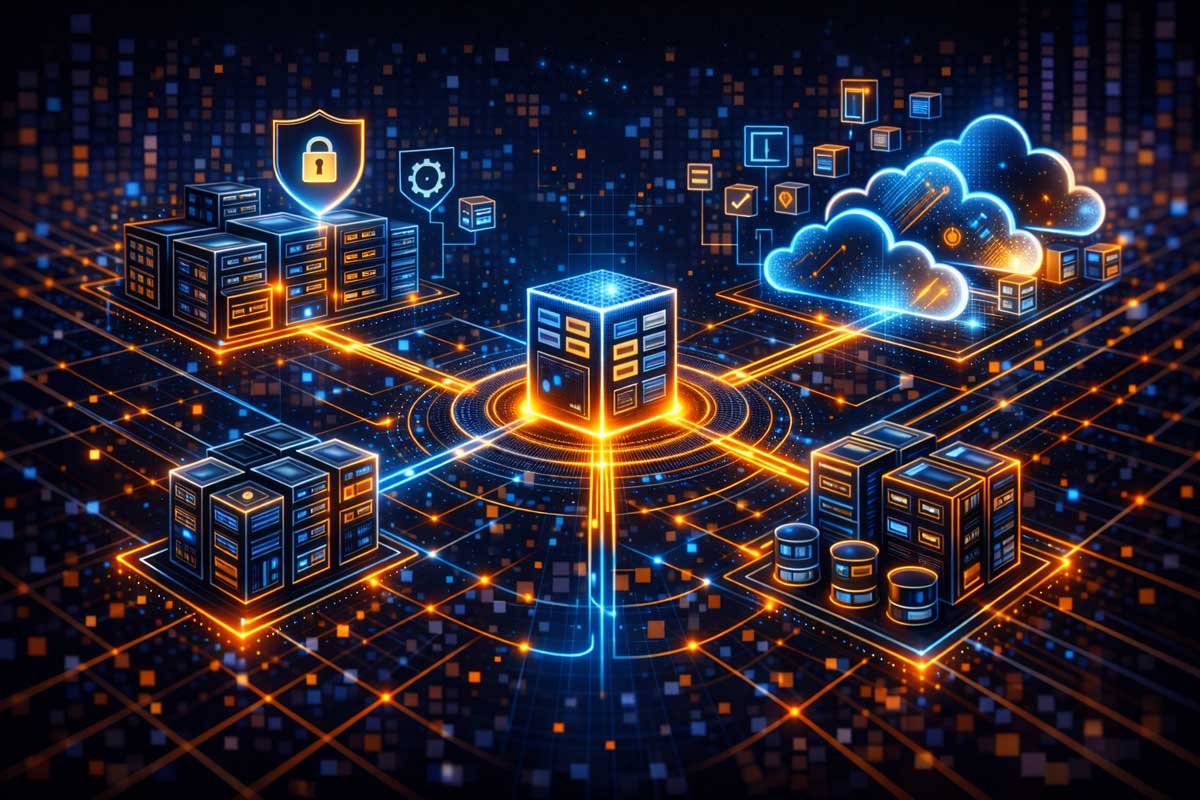
The scaling of state information systems and the increasing volume of interdepartmental data exchange necessitated a rethinking of infrastructure deployment approaches. After the rapid deployment phase of individual solutions, there arose a need to form a stable model that combines security, controllability, and fault tolerance.
This specialized publication summarizes the experience of implementing a hybrid model for deploying server resources for government agencies. It examines the principles of combining private data centers with remote backup sites, as well as the integration of such environments with registries and electronic document management systems.
Architectural Logic of Hybrid Infrastructure
In 2016, the hybrid model involved distributing the load between a primary private data center and a geographically remote site that performs backup and disaster recovery functions. Core application services are hosted in a controlled environment, while critical data is synchronized with the remote infrastructure.
IQusion IT LLC applies server clustering, virtualization of computing resources, and network segmentation (VLAN) in its projects, which allows for flexible load redistribution. This ensures the isolation of services for various departments while maintaining centralized configuration management.
The use of secure communication channels and API gateways enables the integration of the hybrid platform with state registries without direct access to internal network segments. This model meets enhanced security requirements and allows for maintaining control over data.
Backup and Regulated Operation
One of the key tasks of the hybrid model is the formalization of backup procedures. In 2016, regulated scenarios for database synchronization, planned recovery tests, and multi-level storage of backups across different sites were implemented.
IQusion implements centralized monitoring of infrastructure components, allowing for tracking the status of nodes, load, and security events in both environments. All configuration changes are logged, and administrator actions are subject to mandatory audit.
Following the active phase of the conflict and considering the experience of 2014–2015, special attention is paid to distributing critical services across different physical locations. This reduces the risk of simultaneous loss of system availability and ensures the continuity of electronic service provision.
Institutional Integration and Interdepartmental Cooperation
The hybrid infrastructure is considered a foundation for consolidating data from various state sources. Integration platforms ensure controlled information exchange between registries while maintaining the autonomy of each department.
IQusion IT LLC participates in projects where the hybrid model is accompanied by the implementation of internal access regulations, encryption policies, and incident management procedures. This creates a unified regulatory framework for operation regardless of the physical location of resources.
By combining private data centers and remote sites, a scalable platform is formed, capable of supporting the expansion of electronic document management, geoinformation services, and other application modules without compromising system stability.
Long-Term Resilience and Controlled Scaling
The transition to a hybrid model in 2016 signifies a move away from point solutions in favor of a long-term architectural strategy. Deploying resources in multiple environments allows for phased modernization without a complete service shutdown.
IQusion views hybrid infrastructure as a tool for enhancing the manageability and predictability of state systems. Access control, centralized monitoring, and regulated update procedures ensure technological discipline across the entire platform.
In summary, the combination of private data centers and remote sites creates a balanced deployment model that supports stable operation, enhances service availability, and ensures readiness for further integration within the state’s digital infrastructure.